

Persian Miniature Painting
A Three-year Training programme
A progressive, practice-based programme combining live online classes, recorded lessons, demonstrations, independent practice and individual feedback. Students learn through the study and practical recreation of historical Persian miniature paintings, developing technical skills and building a portfolio throughout the course.

The course follows traditional ways of learning Persian miniature painting, in which close observation and the study and reproduction of masterworks play an important role in developing artistic knowledge and practical skills.
Each programme year is divided into a few terms, with each term focusing on a defined group of subjects. This structure gives students time to concentrate on particular aspects of the tradition while allowing flexibility for the different demands of individual motifs and techniques. Some subjects can be explored through several exercises; others require more time and repeated practice.
The breaks between terms provide time to catch up on recorded lessons, complete practical work, practise techniques and prepare portfolios for review.

Year One
Develop foundational drawing skills through the study of landscapes, architecture, human figures, animals, mythical creatures, objects, textiles and decorative motifs. Focus on observation, proportion, line quality, stylisation and shading.

Year Two
Explore painting materials, pigments, colour relationships, brush control, outlining, monochrome techniques and shading. Progress from drawing motifs to painting them using traditional techniques.

Year Three
Study a selected Persian manuscript miniature in consultation with the teacher. Analyse its composition, line, colour and details, then recreate it through preparatory studies and a structured painting process.

Throughout the programme, students build a personal portfolio documenting their artistic development and showcasing their growing skills in Persian miniature painting. Regular portfolio reviews provide personalised feedback to identify their progress and areas for further practice, helping students build confidence and prepare for the next stage of their practice.

Who is this programme for?
-
Beginners and developing artists who want to learn Persian miniature painting through a structured, step-by-step programme.
-
Those with some drawing or painting experience who wish to develop their understanding of Persian miniature painting and its traditional techniques.
-
Those who enjoy detailed, careful work and are willing to practise independently between live sessions.
-
Those seeking a long-term, in-depth and serious study rather than a short intensive workshop.
-
Those who want to develop their own artistic practice by learning traditional painting techniques and exploring the ideas behind them.
Year One : Foundational skills and knowledge
Year One establishes the drawing foundations for the rest of the programme. You will study motifs from Persian manuscript paintings, with attention to form, proportion, stylisation, line quality, characteristic details and the relationship between individual elements and the wider composition. The order and pace of individual coursework may vary according to the subject and the time needed for practice.
TERM ONE
Nature & Architecture
22 Jan - 26 Mar 2027
Fridays, 16:00 - 18:30 (GMT)
10 sessions, 2.5 hours per session; 25 hours total

-
Natural elements, including clouds, trees, flowers, rocks and mountains, etc.
-
Form, volume and the representation of light and shade.
-
Landscape representation in selected historical schools and periods.
-
How landscape elements are stylised and organised within manuscript paintings.
-
Architectural proportions and the representation of various buildings and interiors.
-
Constructing architectural forms using appropriate proportions and conventions.
-
The spatial relationship between landscape, architecture within the composition.
-
Developing a simple landscape composition using elements studied during the term.
TERM TWO
Characters
DATE TBC
12 sessions, 2.5 hours per session; 30 hours total.

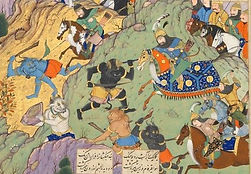
Human figures
-
Anatomy and proportion as foundations for stylised representation.
-
Poses, movements and gestures.
-
Drawing individual body parts and facial details.
-
Representing interaction between figures.
-
Clothing, folds and drapery.
-
How figures are positioned and related to one another in historical compositions.
Animals and birds
-
Animals represented in manuscript paintings, including horses, camels, gazelles, lions, rabbits, foxes, goats and bears.
-
Birds, including doves, cranes, ducks, falcon and peacocks.
-
Stylisation and conventions used to represent animals and birds.
-
The relationship between animal forms, movement and their pictorial setting.
Mythical and supernaturals
-
Creatures including the Simurgh, dragons and divs and angels.
-
Selected historical representations of mythical creatures and their role within manuscript compositions.
TERM THREE
Material culture & Decorative motifs
DATE TBC
6 sessions, 2.5 hours per session; 15 hours total,

-
Objects and material culture represented in Persian manuscript paintings.
-
Textiles, carpets and clothing.
-
Geometric patterns on buildings and their incorporation into architectural compositions.
-
Floral decoration on buildings, interiors and other surfaces.
-
How patterns are constructed, repeated and adapted.
-
How decorative motifs contribute to the visual character of a composition.

If you have any questions about the programme or would like further information, please feel free to get in touch!
TERMS & YEAR FEES & REGISTRATION
You can register and pay term by term. If you choose to pay the full annual fee in advance, an early-payment discount will be available. Registration is open for all terms!
Tuition fees for subsequent academic years will be confirmed once the programme for each year has been finalised. You will be informed of the applicable fees and course arrangements before registering for a subsequent term or academic year.

Do not forget to download "Student Handbook" when you registered, from your confirmation email!